Gravity Light
Local light-cone normal form (ds² = 0) derived from a 2 × 2 commutator.
Coppalini Architecture · current publication
One exact root.
Declared fields. Retained receipts.
A source-preserving mathematical research program: every result carries its source, executable check or proof, and a boundary stating what its conditions establish.
Formal lineage / 24 historical constructions
Twenty-four cited constructions. Each card retains its author, statement, figure, governing equation, conditions, and source address.
Open a card for its construction, stated conditions, source record, and original geometric plate.
Deck source: lineage-data.json · integrity receipt · reference ledger
Featured result · Minimum Mechanics 010
The 010a–010u sequence brings 45 Lean modules into one transitive compiler run. The Proof Atlas now names the exact carriers, theorem statements, source-documented models, physical interfaces, premises, and receipts for local suture–Dirac reduction, Maxwell/ADM identities, finite canonical mechanics, spectral refusal, rational symplectic accounting, and jurisdictional pattern recognition.
Lean 4.33.0 and archive checks pass at pinned commit b9e939d5. The six-bracket theorem takes its seven named SmoothCompletion fields; the shared import graph records source attachment; each physical interface retains its declared carrier, observable, and conditions.
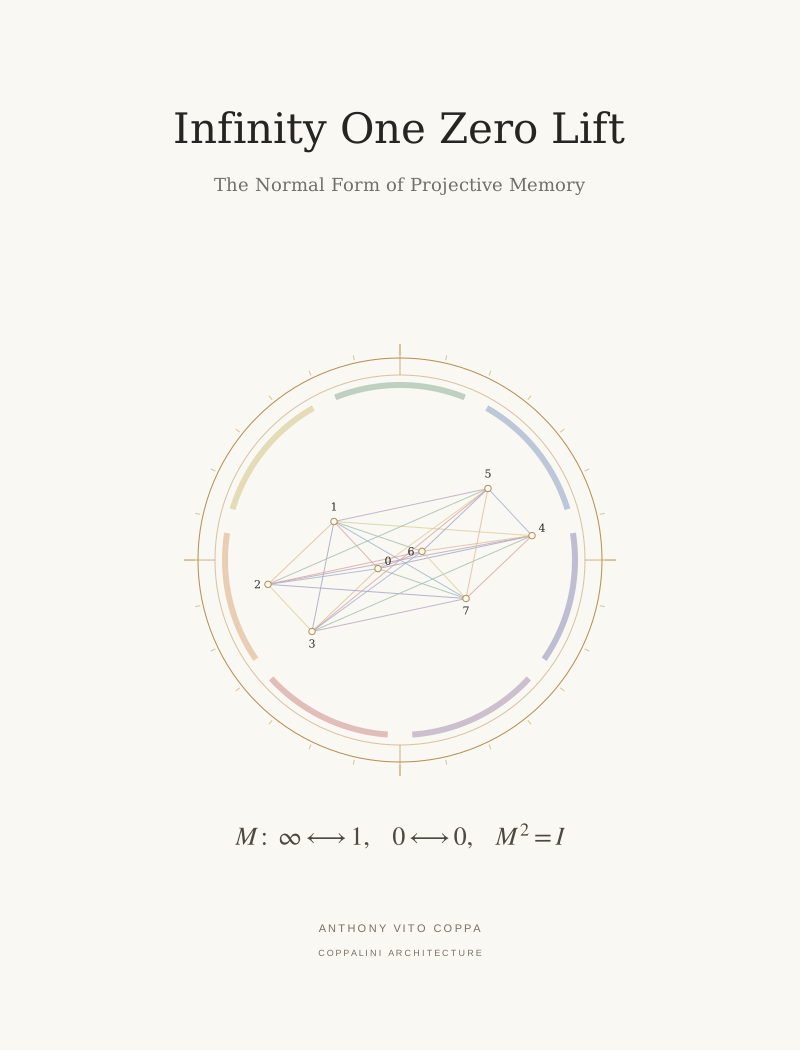
Projective memory · Working edition 0.2
The Normal Form of Projective Memory
A visible form can return while its occurrence advances. This paper gives the exact normal form: a four-phase lift, eight distinct occurrence addresses, all 28 pairwise comparisons, and an explicit inverse that reconstructs the state from its retained reference, agreement, and signed differences.
(p, c, a, D) ↦ (4c + p, a m + Dᵀm)

Mathematical physics
Exact Return, Fibonacci Conjugacy, and the Nonlinear Boundary
A moving observer can recover the three-body relative configuration from complete relative vectors and known masses. For the equal-mass Euler orbit, Newtonian reflection and time reversal provide an exact nonlinear inverse; a selected hyperbolic sector admits the stated Fibonacci conjugacy.
On the stable/unstable cross the local analytic conjugacy holds. The independently checked nonzero fourth-order coefficient establishes the formal and smooth linearization boundary. The sampling interval is chosen; measured Sun–Earth–Moon and biological identifications remain open.
eAhσ* C = C Q² ℛh C = C H
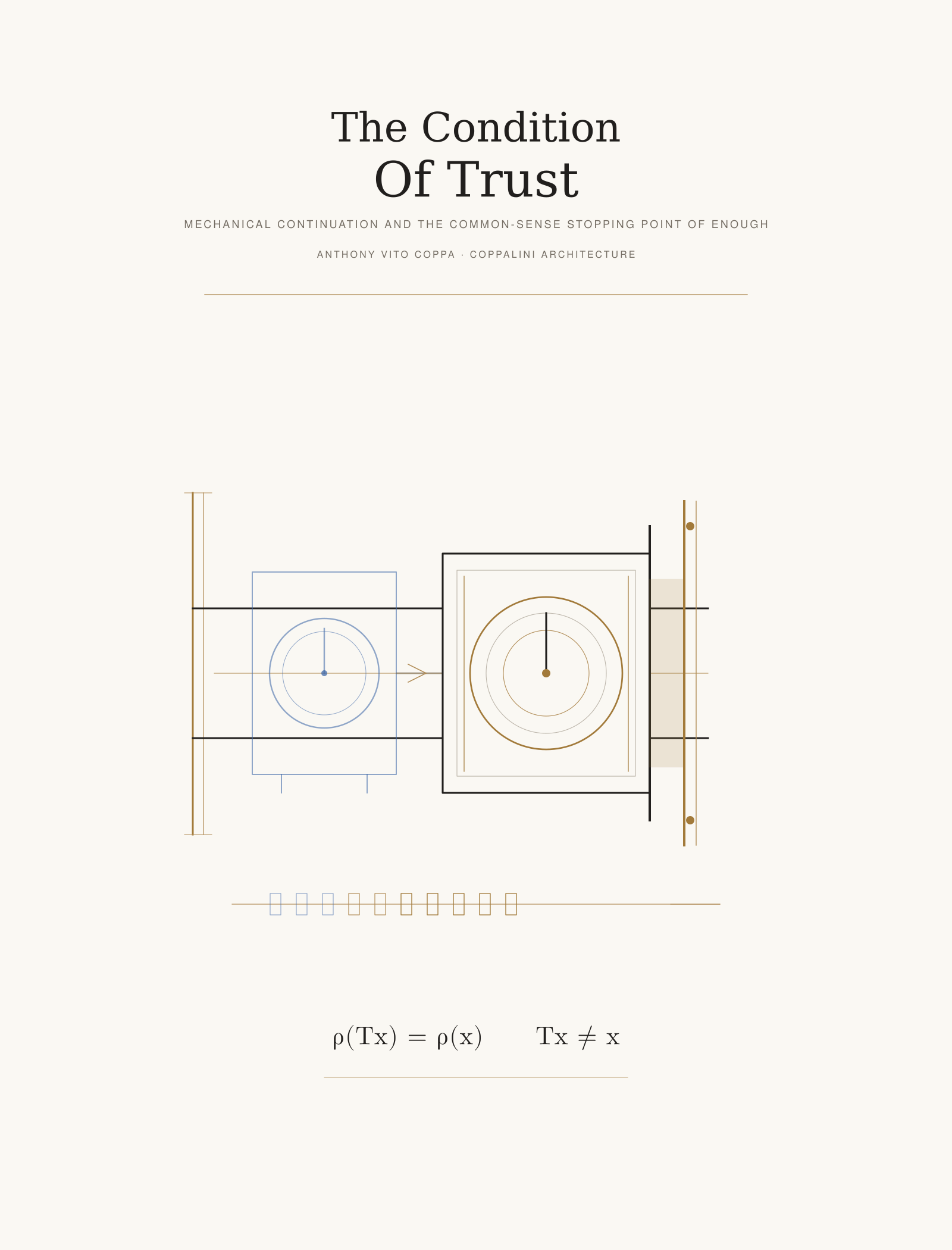
Formal reader
A finite theorem of reader fidelity and sufficient stopping.
For declared states, readings, decisions, and receipts, the paper checks when equal reads require equal decisions, when a receipt can recover its promised history, and when a sufficient work prefix can end. The source, verifier, successful finite receipt, and build receipt remain together.
Four Dual Forms · exact field closure
Gravity–Light, Memory–Motion, Time–Scope, and Horizon–Silence share the exact root Q² = Q + I, C = −Ω, G = [Q, Ω], G² = 5I. Each paper remains independently readable with its own source and stated physical conditions.
Local light-cone normal form (ds² = 0) derived from a 2 × 2 commutator.
Separating repeating phase cycles from cumulative step counts so history is never erased.
Open recordTracking sign and orientation flips (Uπ z = −z) that disappear under unsigned magnitude readouts.
Reconstructing pairwise differences across an 8-node network from zero-curl consistency.
Open recordLive field instrument · Gauge & Matter Laboratory v0.5.3
A finite reader for gauge and matter carriers. Brightness, hue, filaments, and the compass make each declared model legible.
Open the instrument directly to inspect the selected model. The home page retains the orientation and avoids an automatically running embedded simulation.
Electroweak Higgs doublet, U(1) flux transport, SU(3) colour-link transport, and admitted matter carriers retain their declared visual mappings and executable receipts.
One research library
The Library keeps the current proof series and selected primary papers at its head, then continues through the remaining records in a clear historical order. Language Mechanics now carries its own complete fourteen-record source shelf, with each entry directly linked.