Unique three-address map
R([x:y]) = [x:x − y] exchanges infinity and one, fixes zero, and has its second fixed address at two.
Projective memory · Working edition 0.1
The Normal Form of Projective Memory
Abstract
This paper constructs an exact normal form for projective return with retained occurrence. A unique projective involution exchanges infinity and one, fixes zero, and admits an order-four complex lift. Explicit coordinate adapters connect these operators to the Coppalini root algebra. The axial escapement returns its phase every four steps while advancing the cycle address. Two successive cycles supply eight distinct occurrences and all 28 pairwise comparisons, resolved into seven four-edge matchings. For a fixed unit reference, an agreement scalar and the signed comparison record reconstruct the normalized state exactly. The resulting normal form has an explicit inverse on its stated image, supported by written proofs, exact executable audits, and a retained finite Lean subcertificate.
∞ ↔ 1 · 0 ↔ 0
M² = I · U = iM · U² = −I · U⁴ = I
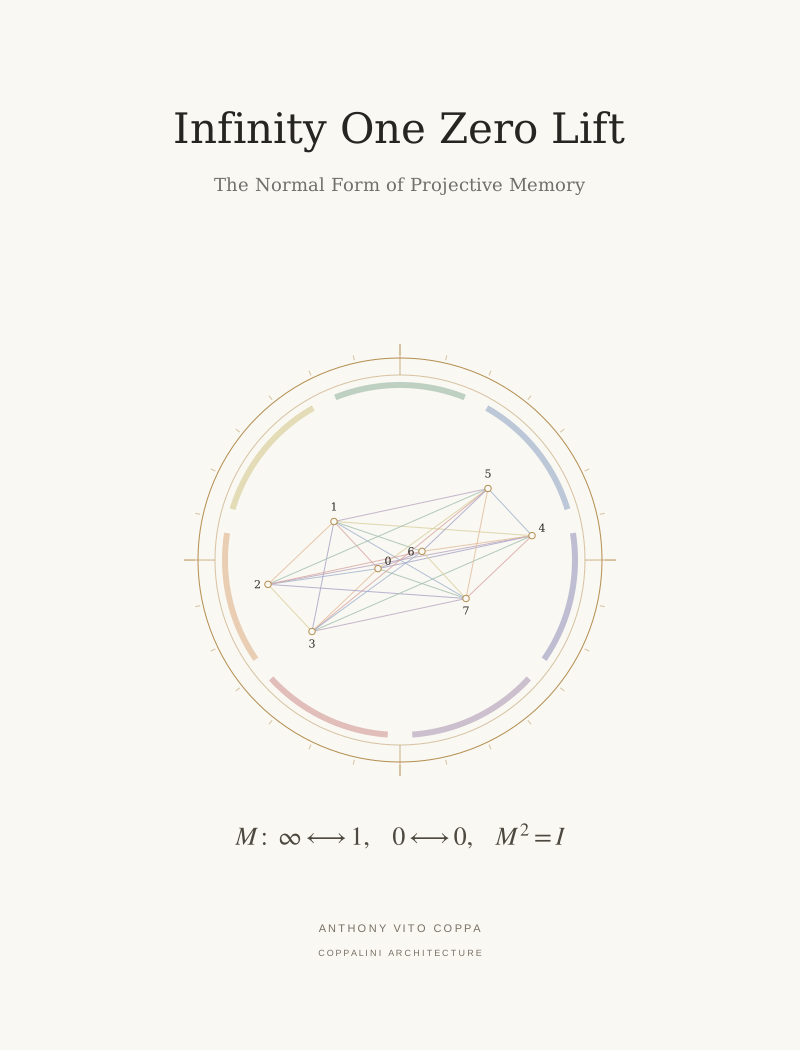
8 occurrences · 28 = 6 + 16 + 6 = 7 × 4 comparisons
Exact reconstruction
For a fixed unit reference m and a unit state r, the agreement a = mᵀr and signed record D = mrᵀ − rmᵀ retain the state. The phase p and cycle count c retain the occurrence address n = 4c + p. On the stated image, the normal form has the explicit inverse:
(p, c, a, D) ↦ (4c + p, a m + Dᵀm)
R([x:y]) = [x:x − y] exchanges infinity and one, fixes zero, and has its second fixed address at two.
F⁴(p, z) = (p, Laxz): the phase returns while the axial carriage advances.
Two successive cycles supply the complete K₈ comparison graph, partitioned into seven four-edge matchings.
Source and verification
The package carries the 15-page manuscript, authoritative TeX source, exact geometry audit, supplementary manuscript checks, and finite Lean source with its execution receipt. The recorded composition passes 73 geometry checks and 31 supplementary checks; the latter distinguish symbolic identities, exhaustive finite calculations, and labeled examples. For this publication, both Python suites were rerun in an isolated copy and reproduced all 104 recorded checks.
Scope
The result concerns the declared projective, axial, occurrence, and signed-state carriers. The reconstruction theorem fixes a unit reference and gives its inverse on the stated image. The preserved finite Lean source carries its recorded execution; the analytic normal form and complete K₈ construction carry their written proofs and executable-audit evidence. Physical applications retain their model equations, timing, and calibration.
The NOP Return / Memory Workbench cites this source for the distinction between returned read, carried state, and occurrence. Its assay model and empirical interfaces retain their own declared parameters and measurement references.